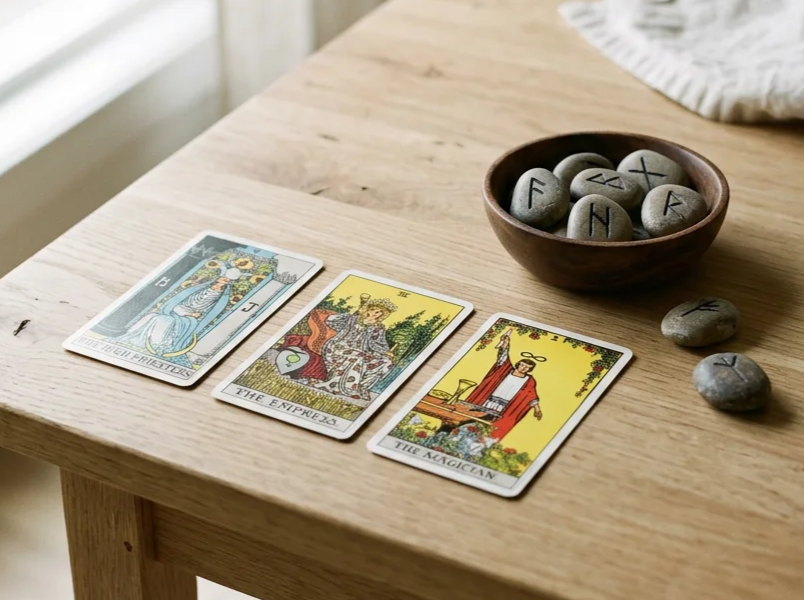
Tarot & Runes Explained
Tarot, Archetypes & the Collective Unconscious
Tarot began as a card game in 15th-century Italy, and since then its use has grown and evolved to help people tap into their inner psyche. The cards’ rich imagery has since inspired many ways of interpreting them, including through the ideas of Swiss psychiatrist and psychologist Carl Jung. Victoria and Albert Museum: A history of tarot cards
Jung described the collective unconscious as a shared layer of the psyche expressed through recurring symbolic patterns called archetypes. He suggested that tarot’s images may be distantly connected to archetypes of transformation. He didn’t create a fixed meaning for each card or claim that tarot predicts a person’s future. International Association for Analytical Psychology · Jung’s The Archetypes and the Collective Unconscious
A traditional tarot deck has 78 cards: 22 Major Arcana and 56 Minor Arcana. The Major Arcana are often read as broader themes or turning points, while the Minor Arcana can highlight everyday experiences, feelings, relationships, and choices. Victoria and Albert Museum: A history of tarot cards
Tarot & Psychology
Tarot can be used as a tool for reflection without treating it as fortune-telling or as something mysterious. The images give us a starting point for conversation. A card may bring a feeling, concern, or possibility into focus and help you look at it from a new angle.
The meaning doesn’t come from the card alone. We explore what you notice in its imagery, what it brings to mind, and how those thoughts connect with your experiences and choices. Through open questions and reflection, a reading can help you name what matters to you and consider a next step.
At Moon & Bloom, I use tarot as a supportive prompt alongside coaching. It isn’t a psychological assessment, therapy, or a source of guaranteed answers. You decide what feels relevant and what you want to do with the insight.
What are Runes?
Runes are characters from ancient writing systems used by Germanic-speaking peoples, including Norse and Anglo-Saxon communities. They were used in Scandinavia centuries before the Viking Age. Old English was also written in runes before Latin letters became more widely used, so it’s more accurate to say that runic scripts predate the widespread use of the Latin alphabet in English. Swedish History Museum: Runes · UCL: The Riddles in Old English R
unes
The Elder Futhark
The Elder Futhark is the earliest known runic writing system. It has 24 characters, and its name comes from the sounds of its first six runes: f, u, þ, a, r, k—with þ representing the “th” sound. The earliest known runic inscriptions date to around the second century CE. They were used by Germanic-speaking peoples across northern and central Europe, including Scandinavia. Swedish History Museum: The first runes · University of Warsaw: Runes and the runic alphabet
Runes were letters used for writing, often carved into objects such as wood, bone, and stone. In Scandinavia, the 24-rune Elder Futhark gradually gave way to the 16-rune Younger Futhark around the beginning of the Viking Age. Viking Ship Museum: Runes
Runes in a Reading
The querent can cast runes as an additional reflection prompt. Casting lots means tossing or drawing marked pieces and considering the symbols that appear. I use the runes to introduce a theme or question alongside the tarot reading.
The rune doesn’t decide what will happen or tell you what to do. Instead, we can ask: What does this theme bring to mind? Does it connect with anything you’re working through? What perspective or next step might it help you consider?
Looking for a written reading? Explore the options below.
Your letter includes:
A personalized tarot interpretation exploring the energies, patterns, possibilities, and choices surrounding your situation
Rune insights that deepen the reading
A photograph of your actual card and rune spread
A beautifully formatted PDF for revisiting whenever you wish
Choose Your Moon Letter →
View a Sample Moon Letter (PDF) →
An example showing the style and depth of a one-question Moon Letter.
Prepared within 3 business days after payment; I don’t use AI to read your cards, so I must give myself some time to prepare.
Your PDF is emailed when ready; postal delivery takes additional time.
Questions & Zoom Reading Requests
I also offer live Zoom (30 or 60 min). For Zoom availability, international Moon Letter mailing, or questions before ordering, use the form below. I’ll reply by email to confirm the details.
Submitting this inquiry form does not place an order or take payment. Zoom appointments are arranged separately, with a secure Square payment link sent when you’re ready to book.
For in-person readings at Akashic Awareness Elizabethtown, KY: view upcoming dates.
Readings support reflection rather than prediction. No outcome is guaranteed; your choices remain your own. Readings do not replace qualified medical, mental health, legal, or financial support.